Showing posts with label Interview. Show all posts

Thursday, August 16, 2012

Film Sketchr Talks To 'Grimm' Concept Artist Jerad S Marantz

Grimm (2011) "Billy" by Jerad S. Marantz
Mike said, "His work always stood out to me before I really knew who created it, because of the striking silhouettes and the unique designs of classic creatures." Jerad S. Marantz creates striking visuals. His creatures are always very distinct.

Jerad S. Marantz (I Am Legend, Rise of the Planet of the Apes, The Amazing Spider-Man) has worked on some of the biggest movies in Hollywood as a creature designer. He also teaches at the Gnomon School of Visual FX, and the Concept Design Academy.

I talked to him about working on the hit TV show Grimm and what its like to be a concept artist, even when you're working on a bad movie.

As always, click on the images to enlarge.


Q: What's It Like When You Look Up At The Screen And See Your Designs Come To Life, And They're Mostly Yours?
It’s incredible. It’s why every concept artist does it. It’s what you hope happens throughout the entire process. Of course it’s a team effort and we're all working towards the same goal which is to get something on the screen that makes everyone happy. But, it's an added plus if what’s up on that screen is yours.

Q: American Horror Story Is Nominated For An Emmy. You Worked On The Show. Tell Us About It.
American Horror Story is created by Ryan Murphy. It’s really well written with amazing story arcs. Last season I designed the Frankenstein baby (Infantata), burnt man and the twins.
American Horror Story "Burnt Man" (2011) by Jerad S. Merantz


Q: Every Movie Can’t Be A Blockbuster. What’s It Like Working On A Bad Movie?
That’s a tough question. There are ways around working on a movie that you think isn't going to be good. As a concept artist I think the guys that last the longest are the ones who are just in love with the process. If the film is great it's an added benefit. I've designed for quite a few films that haven't done well, but I've had so much fun working on them.
Dragonball: Evolution (2009) "Picallo" by Jerad S. Marantz

Dragonball: Evolution (2009) "Assassins" by Jerad S. Marantz


Q: Grimm Came Out This Week And You're One Of The Concept Artists On The Film. What's The Biggest Challenge Of Working On Grimm?
Grimm is a great show and I love working on it. I’m so happy it’s doing well. As a child I loved watching the X-Files and Buffy the Vampire Slayer. It’s always been an ambition of mine to work on a TV show that introduces a new monster every week and it’s about time creatures made their way back to network television.

I get my assignments from Steve Oster (producer). I really like working with him. As a designer you want a client that gives solid feedback and propels the design process forward.

It's a fun challenge in every episode to capture what animal each creature is based on while maintaining the actor’s character in a subtle balance. I’m fortunate to be designing these creatures with my good friend Constantine Sekeris. We compare notes on the show all the time and we are motivated by each other’s work. Constantine has been designing in the industry for a long time and it’s truly inspiring working with him. 


Grimm (2011) "Rhino" by Jerad S. Marantz

Q: When You're Working On A Design For Grimm, Do You Take Into Account The Fact That It Might Be CGI Or Practical?
I’m never sure how the creature design will be executed on screen. At this point I just have to make sure the design can work as a practical makeup and as a visual effect. It’s always exciting to see how they end up using the designs. Either way we have great artists that bring these designs to life.
Grimm (2011) "Gator Man" by Jerad S. Marantz

Barney Burman at B2FX has done the majority of the makeups for season 1 and the work’s been incredible. Every now and then I’ll be in touch with Barney and he’ll tell me how the makeups are going. For the first episode of season 2 I designed a Saber-tooth Tiger man. I was talking to Barney about it and was so excited he was able to flock the makeup and get those teeth top work practically.

Edward Irastorza is the shows Visual FX supervisor. Ed’s in charge of making sure the creatures look their best in CG. He’s done a great job on the show. Grimm is incredibly ambitious with regards to visual FX. I think if people really knew how much work goes into the transformations of these creatures it would blow their minds. Ed was the guy that recommended me for the show and I’ll always be grateful to him for that.

Q: What Led You to Become A teacher?
I teach because I was very fortunate to have teachers myself. Many have been very gerous with imparting knowledge, like Constantine Sekeris, who nutured younger artists and wasn't afraid to share their tricks. They like me, recognize that concept artists are part of a group working to achieve the same goal. Plus, teaching helps keep my skills sharp. It allows an artists to hold onto techniques that they may not otherwise use. A director may say, "I want a sketch" and it keeps my skills sharp in these areas.

I always get very excited when I come across an artist that I think may have a real shot at making it in the industry.

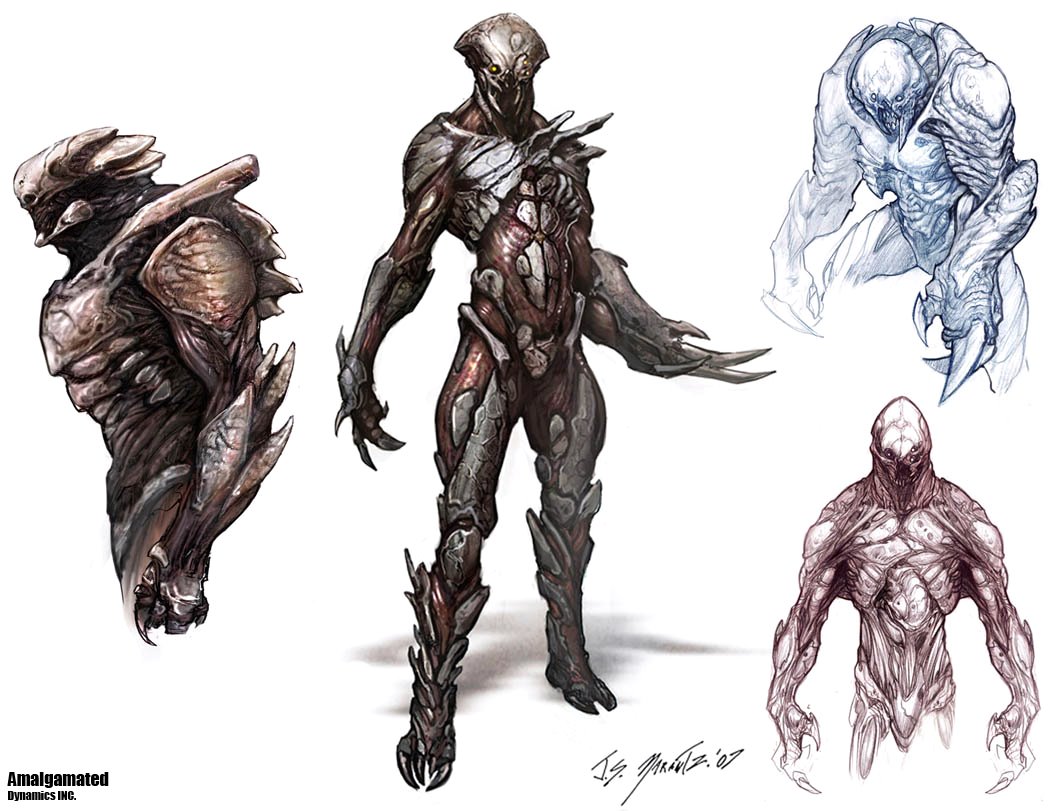
Here are some more concept designs from the television show Grimm.


See more of Jerad S. Marantz' portfolio at jeradsmarantz.blogspot.com.

Make sure you tune in for Grimm on NBC on Mondays and check out the official site http://www.nbc.com/grimm.

What do you think of his illustrations? Did you learn anything from the interview? Can you name which episode each comes from?
 
@ Copyright 2011 GK Productions, Hazy Mills Productions, Universal TV, Jerad S. Merantz. All rights reserved 

Wednesday, August 8, 2012

Concept Artist Constantine Sekeris Talks About Turning Bears Into Monsters For The TV Show 'Grimm' - Exclusive

The second season of Grimm starts next Monday (August 13th) at 10/9 c and I decided to contact some of the artists and share designs and stories for the show.

For those who haven't heard of the show, here's the official synopsis:
"Grimm" is a drama series inspired by the classic Grimm Brothers' Fairy Tales. After Portland Homicide Detective Nick Burkhardt (David Giuntoli, "Turn the Beat Around") discovers he's descended from an elite line of criminal profilers known as "Grimms," he increasingly finds his responsibilities as a detective at odds with his new responsibilities as a "Grimm."

First up is Constantine Sekeris (Blade II, The League of Extraordinary Gentlemen, Jarhead). He talked with me about working on the show and the challenges of designing a good balance of creature and humanity.

Q: What's it Like Working On Grimm?
Its always a lot of fun to work on these creatures because of the theme of the show that has to be retained in the design of the creatures. I’m thankful to be a part of a team on a cool show. I’m very happy that it’s doing so well and audiences like it.

Jerad (concept designer Jerad S. Marantz) and I really like to push the design so people can really enjoy the creativity of the team and we help bring their ideas to life from a cool image. I love it each time I get an email from Steve Oster telling me what the next creature I will be challenged with.

Q: What Was the Biggest Challenge You Faced On Grimm?
My most challenging design was the Bear (Jägerbar) creature it’s hard to take the structure and round shapes with all that fur and bring it into more of a human creature feel so it’s a bit scarier. We had to remove a lot of the hair so it’s not so cute and we had to really be careful that it didn’t look like the werewolves from the show. I think they went with Jerad Marantz take on the character.
It’s great to have an objective and fresh eye like Steve Oster the main producer on Grimm who helps give tips of what is liked and what changes can be made when we all hit a wall sometimes to make the creatures still have a human quality. There has to be a good balance of creature and humanity for the character to work on the show.

Q: How Do You Design Your Creatures?
I begin my process with research and rough sketches to explore the best designs for the show and then render a few options that then go through a decision process with the team and then take the final design to finish. So the prosthetic team of Barney Burman and the digital team have enough time to do their best for the show. I can’t wait for the next creature.
I would like people to know that I’ve come out with a book called MetamorFXof Constantine Sekeris with Creature, Makeup, Robot and Costume design you can find it on Amazon and Barns & Noble.

Thanks for having me apart of your blog.

See more of Constantine Sekeris portfolio at constantinesekerisdesign.blogspot.com

What do you think of the illustrations? Have you seen Grimm? What do you think of the creatures?
@ Copyright 2010 GK Productions, Hazy Mills Productions, Universal TV, Constantine Sekeris. All rights reserved. Used with permission

Tuesday, July 10, 2012

Exclusive: 'The Amazing Spider-Man' Web-Shooters Designed From 'Actual Spider' Said Ed Natividad

[Image]
Ed Natividad is a master concept artist. His most famous work is on Star Wars: Episode II - Attack of the Clones, but he recently lent his skills to The Amazing Spider-Man.

I got in touch with him recently and he shared some tidbits on the designs for the film including why he designed the web-shooters using bicycle parts and helping to design the "iconic suit."  he also sent me some high-resolution images of his work.


Click images to enlarge
 
"Concerning the web shooters, It had always been an issue with me how he could produce an infinite variety of web configurations with one push of a button. After discussions with the production designer, J. Michael Riva, I based the new web shooter nozzle with that of an actual spider." Natividad said.

"All have several 'spinnerets' which discharge the web for a respective function. I visualized there to be three or four independent nozzles which can intertwine the silk to form rope or construct a wide net, ect... It wasn't fashioned after a specific species of spider in this case. 

"Ultimately, the web shooter hardware was to be constructed from items accessible to Peter Parker such as watch and bicycle parts."

[Image]

"Conceptualizing a new Spiderman suit was the next challenge. Under the direction of costume designer Kym Barrett, we set out for a month or two exploring several departures for the character. However, after due diligence, it was time to combine some of those elements with the graphic of the iconic suit.

"Everyone felt that too much of a departure would upset the fans, so the evolution would be in the details and textures."
[Image]


See more of Ed Natividad's portfolio at EdNatividad.com. Please note that I previously used the wrong website as his official site. This has since been corrected.

@2012 Ed Natividad, Marvel Enterprises, Columbia Pictures. Used with permission. All rights reserved

What do you think of the illustrations? Does it make sense to have the spinnerets?

Related Posts

Thursday, July 5, 2012

Exclusive: Concept Artist George Hull Shares His Thoughts on 'The Amazing Spider-Man'

The Amazing Spider-Man set a record grossing $35 million opening day. George Hull (The Matrix Reloaded/Revolutions, Battleship) was asked by the late production designer J. Michael Riva to design a few major set pieces of the film. He "touched on" several things but primarily designed the Oscorp Tower, the Lizard's doomsday device and props, and the Oscorp laboratory/web rooms.

Since the film was very grounded in reality, he said there weren't too many crazy designs. "The film was fairly modest in its conceptual design. That is there weren't giant robots or over the top environments to create." He said, "The items were very specific and I had a lot of notes dictating how the designs should work within the story beats."
Despite this modest design there were a lot of problem solving and limitations, and it reminded him of his Industrial Design background. "When you design products for  the real world application, looking cool is only half of it, there are a lot of restrictions." Hull said. "But I had recently finish a few very high concept design projects like Battleship and Cloud Atlas, so I enjoyed the change."
 
"As a conceptual thinker, I am always looking for artistic challenges in some way. Sometimes a film maker and story asks for fantastic set pieces, landscapes, machines, etc. But not every film is like that and it would be boring if that were the case. For example, on the Amazing Spiderman, one of the items I was tasked with was to make the Oscorp tower look cool, elegant, but not too sci-fi or fantastic. It needed to have certain staging platforms, ramps etc. for a fight sequence. So I did a lot of revisions making that work for the production designer.

"Then the challenge comes in flexing my architectural muscles and turning my stylist brain off for a while. I would say to myself  'well if there isn't a huge aesthetic challenge (blue sky architectural or prop design) , then I will push myself in other ways.' I worked more 3-D on this film than I usually do, so I could fly around tower and offer exciting camera perspectives, or get into the set design specifics more than a concept artist typically does."
The production designer, J. Michael Riva, recently passed away and George shared his thoughts on working with him. "Working with Mike Riva was a huge, huge plus. I worked with him on Iron Man and Spiderman" Hull sadly added "I need to say he was truly an immense talent and an amazingly friendly human being."
You can see more of George Hull's work envisioning a futuristic Seoul Korea in the movie THE CLOUD ATLAS. Then in March 2013, he's worked on the movie ELYSIUM from District 9 director Neil Blookamp.

Be sure to check out more The Amazing Spider-Man illustrations and more of George Hull's portfolio at ghull.com 

What do you think of the illustrations?

Related Posts

Tuesday, July 3, 2012

Kevin Smith's FAT MAN ON BATMAN Podcast Interviews


Over at the Kevin Smith Website they're doing this Podcast Promo called "Fat Man on Batman" where each week they are interviewing major Batman-related Comic Book Artists, Writers, Animation Voice Actors, etc... 


So far Smith has talked with Paul Dini, Mark Hamill ( The Joker, 2 parts ), Tara Strong ( Batgirl ), & Arleen  Sorkin ( Harley Quinn ). They have all actually been very very good so far. So, if you're a big Batman Fan please be sure to check them out. Just click HERE!

Saturday, June 16, 2012

VIDEO - BATMAN RETURNS - Rob Burman on Mold Making and Movie Costumes

Check out this amazing Video about the filming of the 1992 BATMAN RETURNS Movie directed by Tim Burton. This is a short documentary and interview with Rob Burman for his work on "Batman Returns" as a Mold Maker and Costume Fixer. Produced and shot in High Definition and mixed in Surround Sound by Rennie Cowan.  All set photos you see in this documentary are authentic and property of Rob Burman who worked on Batman Returns. Burman personally gave the photos to the director for use in this video. The stunt double for Michael Keaton, Dave Lea, also provided an image.


CLICK HERE For More Batman Returns Video!

Friday, May 11, 2012

10 Good Questions With Storyboard Artist Warren Drummond

Jackie Chan (left) and Warren Drummond (right)
Bruce Lee said, "Absorb what is useful, discard what is not. Add what is essentially your own." Warren Drummond is a martial arts expert. He's also a storyboard artist. Put the two together and you get a Kung-Fu concept artist. Drummond has made storyboarding his own.

I first saw his storyboards from Rise of the Planet of the Apes, but he's been working in the industry since 1994 on everything from A Beautiful Mind to X-Men: First Class.

He agreed to an exclusive interview to answer ten important questions. He names his favorite artists, the movie that didn't give him credit and the connection that helped him meet his wife.

Rise of the Planet of the Apes


Q. When you began your journey as a designer you probably had a few role models, would you name two of your favorite artists?
My favorite artists were my older brother, John Drummond Jr, as well the great John Romita Sr. I saw my brother's work all the time. His work was astounding. Professionals thought he should have gotten into comics, though John preferred fine art. Romita Sr's balance of anatomy and storytelling was only second to John Buscema (a LOT of "John's, eh?). Romita Sr was a better inker than Buscema, who was often inked by others. Buscema though drew the human body better than anyone.

Q. What has been your greatest artistic achievement in your life so far?
(Image: Nash chase - A Beautiful Mind)
Just getting FINALLY  into the movie business almost 20 years ago and STAYING in it. I believe my work on A BEAUTIFUL MIND was a high point as I worked with Ron Howard and the movie won Best Picture. I was on it seven weeks. My friend, storyboard artist (and current 2nd Unit director as well) Brick Mason brought me on to help him. last fall, I got to do over a month on reshoots for THE AMAZING SPIDER-MAN. I hope it rocks.

I got to work a week on STAR WARS: ATTACK OF THE CLONES, thanks to being buds with the stunt coordinator, Nick Gillard. I spent a blissful, geek-laden week at Skywalker Ranch.


Q. How has your martial arts training influenced your storyboard designs?
(Image: Martial Arts study - personal)
Martial arts has given me discipline and has kept me in shape to work those long hours. There are many martial artists I admire, Benny Urquidez, Anderson Silva, all of my previous instructors (who are all still in my life), and of course my hero, Bruce Lee.

Lee had an open mind to new things, as well as to keep trying to get better, and I have tried to hold on to that. There were also MANY unheralded black martial artists like Moses Powell, Steve Sanders, Carl Scott, etc whom I am sure I got something from if only through the ethers.

Q. What's it like seeing your storyboards come to life on screen?
On a movie like SHAFT (2000) it was unreal as John Singleton often sticks close to his boards when they are needed. It also does not hurt the ego to see your name in the credits.

It does SUCK, however, when you work hard and they DON'T credit you. Hello, "ANALYZE THIS"!!!!

Q. What was your favorite memory during your time on Rise of the Planet of the Apes?

Working with the director, Rupert Wyatt, a great guy, who's also so smart. I just loved the whole "process".

Q. What is your favorite movie and how many times have you seen it?
JAWS. I can't count how many times I've seen it. Perfect film. SUPERMAN and STAR WARS made me want to get into the business. I STILL have yet to meet Spielberg!!!

ENTER THE DRAGON is in the top ten. Waahhh!!!

Q. What was your most surprising inspiration for a storyboard?
(Image: Fast and the Furious 3: Tokyo Drift)
Music certainly brings out different attributes, but many artists listen to some form of music while working. I listen to John Williams scores, The Beatles, or a Tribe Called Quest (Jamaica Queens in the house!!!).

Q. You said in an interview that your first love is writing. Is there a pet project you have in mind you can talk about?
Nothing I can mention now, but my "coverage" on my current script went quite well. Let's talk in a year.

Q. In your line of work networking is key. What's the most amazing connection that networking has brought you?
Well, I met my wife through director Carl Franklin and his wife, producer Jesse Beaton. Knowing Brick Mason landed me Ron Howard. John Singleton got me work with Denzel Washington when Denzel directed ANTWONE FISHER. Working with on that movie introduced me to the wonderful producer Todd Black. Years later, Todd optioned a script from my wife.

Q. What’s next for you? What other projects can we look forward to seeing?
A just landed a few days helping out on a movie called THE TOMB (2013). I get to finally draw Arnold Schwarzenegger and Sylvester Stallone. No, I can't talk about it (LOL), but I really like the script.

See more of Warren Drummond's body of work at WarrenDrummond.com and check out the list of other artists I've interviewed here.

What do you think of the illustrations?

Tuesday, May 8, 2012

Exclusive: Nathan Schroeder Talks About The Scene That Panicked The Artists

I featured some concept art from The Avenger's Helicarrier before, but one of the main artists who helped bring the S.H.I.E.L.D. Helicarrier to the screen was Nathan Schroeder (Thor, Star Trek, Captain America: The First Avenger) and I got an exclusive interview with him where he talked about his designs and the challenges of redesigning one of the most iconic vehicles in comic book history.

Nathan repeatedly said that there were many talented designers that worked on the S.H.I.E.L.D. Helicarrier. But, James Chinlund, the production designer, said "the key designer on the piece was Nathan Schroeder, who was elbow deep for several months helping to bring the ship to life."

I'm sharing some exclusive photos, but you can see more on his site. Here's what Nathan had to say about the designs, the challenges and the one scene that caused them to panic.


"I was really happy how it turned out. Joss Whedon did a great job with it." he said. While he didn't work directly with director Joss Whedon, as is typical in the industry, he did work with James Chinlund the production designer.

Whedon would talk with Chinlund about elements of the Heli-Carrier that had story implications. Where would the engines be and what would the technology be like? He would need this information to block out the scenes.

When the designs of the Helicarriers were first done there was a lot of speculation about how to do it. 

“It’s basically an aircraft carrier in the sky,” said director Joss Whedon. “Throughout the years, the look of the Helicarrier has evolved in the comics, but it was always the idea of this floating fortress. It was part of the bargain in writing the script that it had to be included, and I wasn’t about to say no. We had a lot of discussions on figuring out how to make it work, but the streamlined design that our production designer James Chinlund came up with was very sleek and cool, but it also toed the line between fantasy and reality very well.”

The designers went through many phases from submarines with propellers to flying boats. In the end they went for a more militaristic look inspired by Steve Jung. The following are some of Schroeder's concept designs.


The Lab
He didn't get to read the script because of security concerns, but he was given details that he needed. One scene in particular he mentioned was the scene with the lab when Banner "Hulks out" and is attacked by a plane.

"I had to develop the construction of the lab specifically based on what they needed for this scene." Nathan said. He went as far as having to determine where the stress points were. For example, Whedon wanted to know if the windows blow out or just have bullet-holes in them? Is the lab completely destroyed and burnt or is it useable afterwards?

The Bridge
The bridge was a collaborative effort with set designers and artist Steve Jung. Nick Fury could stand in several locations and there was a table that the Avengers could have meetings in.

One of the "biggest challenges was the front window," which was a real stage and was a "big engineering job." The questions the designers asked was "How do you make it look cool and still actually make it structural?" The metal can't block shots, but the spacing and girders had to look strong and futuristic.

The contribution he talked about most were the angled "mullions," or two massive struts, that give it a dynamic attitude and the struts point right to Nick Fury.


The Helicarrier Ascending
What was most surprising to me was how the scene of the Helicarrier ascending from the water led to a structural change of the ship. That scene actually happened kind of "late in the time that" he was involved.
"Originally the reveal was going to happen right at the beginning. The end of the Captain America movie was going to be dovetail right into this. He was going to wake up, kind of stumble outside this building that looks like a modern office building and he keeps walking and he realizes he's on this tarmac and he gets to the edge and he realizes he's on the edge of the aircraft carrier looking down floating over the city and that's kind of his introduction to the modern world.

"At some point, Joss must have decided that it would be more dramatic to do the takeoff from the water. We had the design of the carrier with the wings flush at the flight deck level. Which means that you're going to see them as soon as you see the carrier and we need to hide them under the water. So, we had to come up with some way that the wings could actually move. They kind of climb up and down on the side of the ship. So they start underwater, and if you pay really lose attention, they kind of elevate upwards and lock into a final position. If you see the original, when its in the water you can see there is bit of folded pieces where the wing is. And if you look at the underside of the Helicarrier you'll see that I put in some tracks on the front wings and back wings to suggest that's how it rides up and down.
"When that decision was made we went into sort of a panic mode. How do we get the wings out of the shot and still make it look [right?] It has kind of a nice aggressive posture when the wings are up higher and if you bring the wings down it's not as interesting."
Overall, he said it was a "great time" working on the Avengers with James Chinlund and the other artists. He was "very open to trying stuff in 3-D" and technology.

"I would also say, as any artist, that we all work on a lot of movies and it's really great when the movie turns out well." Nathan said thoughtfully. "Because we all invest a lot of energy into these movies. It's really satisfying. All that work was really worthwhile."

See more of Nathan Schroeder's portfolio at http://www.nathanschroeder.net/
and Steve Jung's work at http://www.stevejung.net/ and http://jungsketch.blogspot.com/

What do you think of the illustrations? Did you like the Helicarrier?

Related Posts

Monday, May 7, 2012

Pete Von Sholly On Working in Over 100 Films And Why Peter Jackson's 'King Kong' Is Not Impressive

When I first heard about Pete Von Sholly it was when his artwork was featured as being concept designs for the Tim Burton film Superman Lives. But, he's worked on over 100 feature films include Mars Attacks!, Disney's James and the Giant Peach, Darkman, The Mask, The Shawshank Redemption, The Blob, Nightmare on Elm Street III and IV, The Waterdance, The Green Mile, Click, The Mist and more. His political satire Capitol Hell Political Monsters Postcard Book has been talked about all over the Internet.

Sholly is talented, outspoken and a ton of fun, so I'm really glad he agreed to do this interview for my blog. You'll find fascinating insights and and exclusive artwork after the jump.
Pete Von Sholly Mars Attacks concept art

Q. You have been in concept art and storyboarding for many years. What led you to work in this industry?
(Image: The Mist storyboard)
First, THANK YOU, for all the kind words. Much appreciated. Movie work is so "behind the scenes" one seldom gets to hear from anybody outside any given production, which is why your blog is so great. So "the guys" get to show what they can do, you know? (Yes, yes, "the girls" too!)

Anyway, I always loved comics and the movies and my first professional work was in animation (television mainly) where I found out there was a field where you could actually get paid real money to draw! What a concept! Then I saw storyboards and thought they looked kind of like comics and thought maybe I could learn how to do them. Some great guys helped me learn the ropes (Art Vitello and Larry Houston while we were at Marvel Productions) and they taught me the key differences between the print and film media. Mainly when you draw for film you have to honor "screen direction" and think about how your shots will cut together, quite different from laying out a comic book page.

Persistence and some networking helped me get a toe-hold in movies. The first two I did (of any note) were VAMP and A NIGHTMARE OF ELM STREET 3: DREAM WARRIORS. This led to other work for New Line Cinema and I met Frank Darabont while there- who later hired me to board THE SHAWSHANK REDEMPTION, THE GREEN MILE, and THE MIST.

Q. One of your first storyboarding jobs was on Nightmare on Elm Street. How did you get involved in that and what was it like?

Oops! Already kind of covered that. But that film (the third one, not the original Wes Craven one) led me to meet Chuck Russell who I liked and had fun with. He later hired me to do THE BLOB remake and THE MASK. Had a ton of fun with Chuck and with all the New Line crowd. It was a small company then.


Q. You've done a lot of comic book and cartooning work. How does this art style help you in your movie and television work?
(Image: The Shawshank Redemption (1994) storyboard)

I think comics and cartooning are great because apart from the basics like anatomy and perspective and composition, you learn to make your characters emote. This is helpful for storyboards. Brain Yuzna once told me he liked my boards because you could always tell not just what the characters were doing but how they FELT about it! Simplicity and clarity are my goals.


Q. Was there anything in particular that inspired you to take that direction or was it all natural and pure brilliance on your end?
Oh, all natural and pure brilliance, absolutely. (Sorry, that was TOO good to pass up!)

I think I want to see certain things in comics and movies (and we all do) and so we become "the guys we always wanted to be" as my old pal Dave Merritt says. Dave runs the model shop at Legacy (and did the same for Stan Winston for years). I think we make the stuff we always wished somebody would make. Or try to anyway.


Q. You seem drawn back to the original King Kong film time and time again. How many times have you seen it?
Dunno. A BUNCH though! Love Skull Island. I'm always sad when they leave for NY! It had the feeling of a place where giant prehistoric things could actually live and seemed like it could go on forever even though it was just an island! Of course, it was chock full of DINOSAURS which put me in cinema heaven right away. I went to a show at the Academy theatre V a few years ago (or whatever it was called) where some of the WETA guys were touting their effects work on Pete Jackson's King Kong. They were boasting about how their wonderful animators were able to bring tears to audience's eyes with the way they brought Kong to life and made you feel his tragedy when he died... I so wanted to stand up and mention, yes all very well and good, but don't forget how Willis O'Brien ALSO did that with a f***ing rubber and metal PUPPET along with Max Steiner's wonderful music back in 1933! A bit more impressive an accomplishment than what you can do with tons of CG and virtually unlimited money nowadays.


Q. Do you prefer digital or traditional art tools?
Both. Love to draw and ink on paper! Love pencil and paper. But I also love what I can do once I have the drawing down by getting it into Photoshop and going to town. I like the luxury of having "thinking time" as Alex Toth called it... and the ability to revise and change the work later on if I get a better idea, which I can sometimes only do when I'm not too close to it.


Q. When you began your journey as a designer you probably had a few role models, would you name two of your favorite artists?
(Image: Jack Kirby Captain America comic panel restoration study)
Only two?? Jack Kirby and Jack Kirby. No, I loved Frazetta too.


Q. How does it feel to have your designs come to life?
It’s fun, of course, but I have to tell you something. When you work on a movie it's hard to ever SEE that movie as a normal audience member; you KNOW too much. I have had more work come to life from storyboards than designs.

Q. What advice would you give to newbie designers?
Find your own thing by working at it a lot. Watch King Kong (1933) and other "old movies" too. For storyboarding, watch a lot of good films (like anything by Hitchcock) with the SOUND turned off so you can really notice the cutting. Find what excites you. And remember, nothing pays off more than pure persistence. Don't give up and don't forget how much you WANT to do your art.

Q. Lastly, what can we expect to see from you in the future?
I have a giant HISTORY OF MONSTERS mural book in the works (2013), a two volume PETE VON SHOLLY'S MONSTERBOOK from TwoMorrows (sooner!), a ZOMBIE POP-UP BOOK in the works, some secret personal projects- one of which could be epic! What else? Writers Blocks. I don't know. A lot of stuff which may or may not see the light of day. You might like SPINECRAWLER, a graphic novel I adapted from a script I wrote. IDW published that last summer. I do stuff because I want to and feel it NEEDS doing, not because somebody promised to publish or produce it. WORK is for making money. Art is for your soul.

Check my blog once in a while, maybe. I will post stuff on there as it comes forth.

Thanks for asking all of the above and I hope there is some modicum of info or entertainment or something to be found in the answers.

And keep your OWN stuff coming too, MM- your blog is wonderful!

Thanks Pete!

See more of Pete Von Sholly's portfolio and commentary at VonsHollywood.com and http://vonshollywood.blogspot.com.

To read more of my exclusive interviews with talented artists go here.

What do you think of Pete Von Sholly's work? Did you learn anything you didn't know?


Related Posts